
Decommissioning of petroleum infrastructure and wells
Holders of petroleum exploration permits, mining permits, and licences must decommission their infrastructure and wells at the end of their operation and meet the full financial cost of doing so.
Decommissioning is the process of permanently retiring petroleum infrastructure and wells in a way that manages risks and ensures sites are left in a safe and stable condition, so they do not pose ongoing safety or environmental risks.
It usually includes:
- plugging and abandoning wells
- removing equipment and facilities, and
- restoring sites to a safe and stable condition.
Decommissioning can be complex and costly. It must be carried out safely, responsibly and without leaving risks and costs to the Crown, communities, or landowners.
Roles in decommissioning
Decommissioning involves multiple parties, each with different roles and responsibilities.
Permit and licence holders
All permit and licence holders are responsible for:
- planning how petroleum infrastructure and wells will be decommissioned
- providing evidence and information to support decommissioning decisions, which can include plans, cost estimates, asset registers and financial and capability information
- ensuring they have the technical capability and resources to carry out decommissioning
- fully funding and carrying out decommissioning of their petroleum infrastructure and wells in line with all relevant regulations and legislation.
New Zealand Petroleum and Minerals
We administer and regulate permit and licence holders’ financial and technical capability to meet decommissioning responsibilities under the Crown Minerals Act 1991. This includes:
- assessing whether permit and licence holders have the capability and financial resources to meet their obligations
- ensuring permit and licence holders have financial security arrangements in place to meet the cost of decommissioning when they arise
- reviewing decommissioning plans, cost estimates and supporting evidence
- advising on requests for exemptions from holding financial security for meeting of decommissioning obligations.
Other agencies and regulators involved in decommissioning
Different agencies and regulators are responsible for approving decommissioning requirements for removal of infrastructure and ensuring decommissioning is carried out safely and in line with the relevant requirements, depending on the location and nature of the activities.
This can include:
- The Environmental Protection Authority (EPA) for offshore activities, beyond 12 nautical miles offshore.
- Regional councils and territorial authorities for activities onshore and up to 12 nautical miles offshore.
- The Department of Conservation for projects that include conservation land or protected areas.
- WorkSafe New Zealand for health and safety regulations around decommissioning activities.
The Environmental Protection Agency is responsible for activities that take place between 12 and 200 nautical miles offshore, in an area called the Exclusive Economic Zone.
When the EPA approves marine consents for offshore exploration or production activities, it considers decommissioning, and the consent may include requirements for when the infrastructure reaches the end of its operational life (end of life).
In addition, before decommissioning can occur, decommissioning plans must be submitted to the Environmental Protection Agency. If structures will not be completely removed (or if there are submarine pipelines), then the proposed decommissioning approach must be the best practicable environmental option. Only once these plans are approved can permit or license holders apply for the marine consents needed for decommissioning-related activities.
For more information about decommissioning plans and environmental requirements, see:
- Exclusive Economic Zone and Continental Shelf (Environmental Effects—Decommissioning Plans) Regulations 2021— New Zealand Legislation
- Regulations for decommissioning offshore oil and gas infrastructure — Ministry for the Environment
Regional councils and territorial authorities are the decision-makers for the decommissioning of infrastructure and wells onshore or up to 12 nautical miles offshore.
Decommissioning and restoration are considered when a consent is first granted for exploration or production activities. These consents may include required activities at end of life, such as the removal of site infrastructure, replanting vegetation, or re-establishing wildlife.
Deliberately disposing of or abandoning an offshore installation is “dumping” and requires a coastal permit. Other work, including removing infrastructure, disturbing the seabed or making discharges, may require different or additional approvals.
Local authorities may also hold a bond for the restoration of the site, and further or separate consents may be needed when infrastructure is decommissioned.
For more information about consent requirements, restoration obligations and approvals for decommissioning activities, see:
- Resource Management Act 1991 — New Zealand Legislation (soon to be replaced by the Natural Environment Bill and Planning Bill)
- Resource Management (Marine Pollution) Regulations 1998 — New Zealand Legislation
The Department of Conservation manages public conservation land, and the Hauraki Gulf/Tīkapa Moana protected areas. Access arrangements are required for prospecting, exploration and mining in these areas.
Each arrangement will outline the individual requirements for the site when it is decommissioned.
For more information about mining activities on public conservation land, access arrangements and site restoration requirements, see:
- An applicant's guide to mining activities on public conservation land [PDF 657 KB] — Department of Conservation
- Prospecting, exploration and mining: Apply for permits — Department of Conservation
WorkSafe New Zealand regulates workplace health and safety according to the Health and Safety in Employment Act 1992. This Act applies to all New Zealand workplaces and is intended to prevent harm to all people at work and others around places of work.
The Health and Safety at Work (Petroleum Exploration and Extraction) Regulations 2016 set up specific requirements for decommissioning activities, including safety case requirements. A revised safety case must be submitted to WorkSafe if decommissioning activities significantly change the risks, systems or operations covered by the existing safety case. Decommissioning must occur in a manner that is consistent with the accepted safety case and any conditions or limitations imposed by WorkSafe.
For more information about safety case requirements and health and safety obligations during decommissioning, see:
- Petroleum guidance for the petroleum industry — WorkSafe
- Health and Safety at Work (Petroleum Exploration and Extraction) Regulations 2016 — New Zealand Legislation
Decommissioning obligations and the permit lifecycle
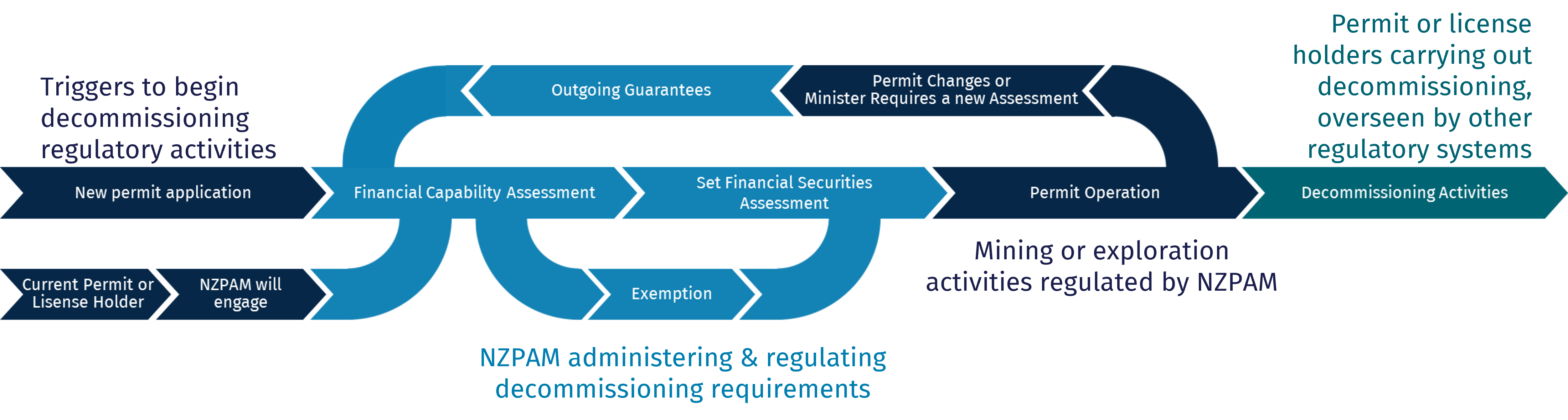
Before a permit is granted
The Minister must be confident the applicant will have the ability to carry out and pay for their decommissioning obligations, before granting an application for a new permit. If you make an application, you will be required to provide information to support this decision.
Apply for petroleum permits and manage current permits
During the lifecycle of a permit
The Minister may assess a permit or licence holder’s financial capability after a permit has been granted. This assessment helps ensure that decommissioning obligations and related decisions remain appropriate.
To ensure funds for decommissioning are available when needed, permit and licence holders must establish an acceptable financial security. We usually assess whether a financial security arrangement is appropriate after assessing the permit holder’s financial capability.
Financial capability and financial securities guidelines
If permit or licence holders think that their decommissioning obligations are not appropriate, they can apply for an exemption or deferral.
Exemptions and deferrals from decommissioning obligations
If changes are made to a permit
Certain changes to a permit or licence, such as changes to the operator, ownership, or control, require the Ministers approval. When advising on these changes, we may consider the permit holder’s ability to meet their decommissioning obligations.
Change of control - Petroleum permits
Some changes also require the Minister for Resources and Minister of Finance to decide whether an outgoing guarantee is required from the exiting party (or a party related to them).
After a permit has been successfully decommissioned
Once petroleum infrastructure and wells have been decommissioned in accordance with the relevant requirements, a permit or licence holder’s primary decommissioning obligations under the CMA are complete. However, responsibility may continue if post-decommissioning issues arise, and a permit or licence holder may be required to provide information, assurances, or take remedial action to address risks or impacts.
Establishing acceptable financial security arrangements
The Government legislated Financial Capability and Financial Security arrangements in the wake of the issues affecting Tamarind Taranaki and its inability to fund the decommissioning of the Tui oil field.
Learn more about the Tui Project:
Tui Project: decommissioning the Tui oil field – Ministry of Business, Innovation and Employment
Following by engagement with permit and licence holders in October 2025, we have begun to establish acceptable financial security arrangements.
The process generally includes:
- assessing any exemption or deferral applications for petroleum infrastructure or wells
- undertaking a financial capability assessment of the permit or license holder
- the permit or licence holder proposing a financial security arrangement
- the Minister for Resources determining an acceptable financial security arrangement
- documenting and establishing the accepted financial security arrangement.
To manage the workload and support an efficient process, permit and licence holders have been allocated to one of three tranches. Each tranche generally progresses sequentially through the steps outlined above.
The first tranche began in October 2025, and we are communicating with the further permit and license holders as we progress through each tranche.
For more information on financial capability assessment and financial security arrangements see:
Financial capability and financial securities guidelines
More information
Detailed information on decommissioning can be found in the Crown Minerals Act 1991 and the Minerals Programme for Petroleum 2025.
Crown Minerals Act 1991 — New Zealand Legislation
Minerals Programme for Petroleum 2025 [PDF 1.8MB]